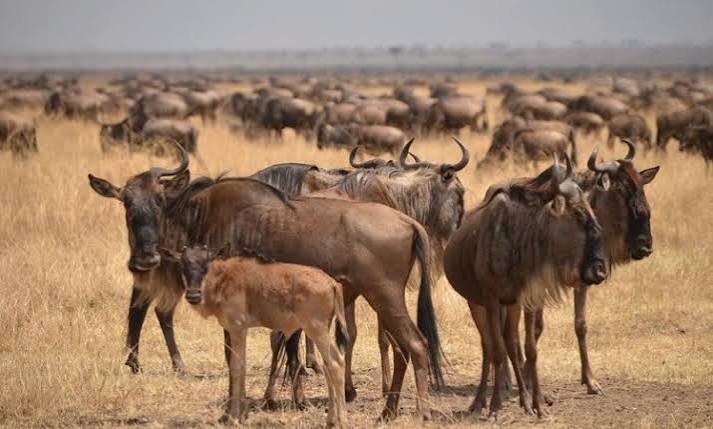
The Amazing Wildebeest Birth in Ngorongoro Crater, Tanzania ;Tanzania is famous for its extraordinary wildlife, but there is another side of the wilderness that is just as fascinating as seeing lions, elephants or leopards: the beginning of new life.
Across Tanzania’s national parks, conservation areas and grasslands, animals are constantly being born. Calves take their first steps, young elephants stay close to their mothers, zebra foals learn to follow the herd, and predators raise their cubs in the safety of carefully chosen territories.
This natural cycle of birth, growth, survival and reproduction is one of the most important parts of Tanzania’s ecosystems.
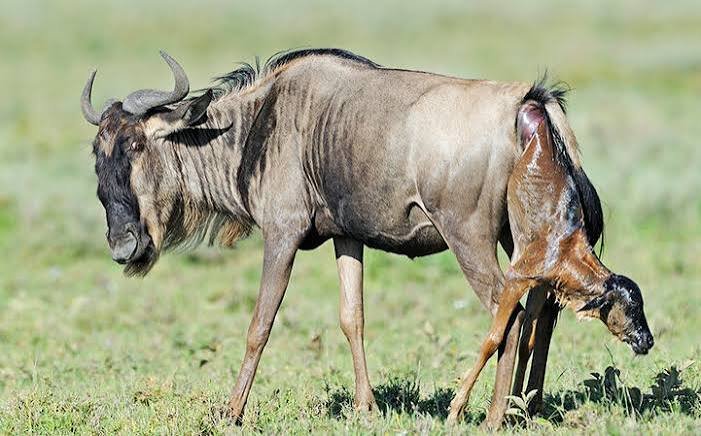
And sometimes, a safari gives you the privilege of witnessing one of the most extraordinary moments of all: a wildebeest giving birth and a newborn calf taking its very first steps.
Inside the spectacular Ngorongoro Crater, this experience can be particularly unforgettable. The ancient volcanic landscape, green grasslands, lakes and surrounding crater walls create a dramatic setting for one of nature’s simplest but most powerful stories the arrival of a new life.
The newborn calf may look fragile at first.
Its legs tremble.
It struggles to stand.
It falls.
Then it tries again.
Within a surprisingly short time, instinct begins to take over, and the calf starts following its mother.
For a traveller sitting quietly in a safari vehicle, this can become a moment that is remembered long after the safari has ended.
Why Animal Reproduction Is So Important in Tanzania
Every successful birth contributes to the future of Tanzania’s wildlife.
Animals reproduce to maintain their populations, replace individuals lost through natural causes and ensure that their species continue to thrive.
But reproduction in the African wilderness is not easy.
Newborn animals face numerous challenges from the moment they enter the world.
They need to find food.
They need water.
They need protection.
They must learn to move with their mothers and eventually with the wider herd.
And they must avoid predators.
This is why the early life of a wild animal is such a remarkable story of survival.
Different species have evolved different strategies.
Some animals give birth to several young at once.
Others invest enormous amounts of care in a single offspring.
Some newborns can walk almost immediately.
Others remain hidden for days or weeks while their parents protect them.
Tanzania’s wildlife landscapes provide a living classroom where these different survival strategies can be observed in nature.
Wildebeest Reproduction: A Remarkable Survival Strategy
Among Tanzania’s most famous herbivores, the wildebeest has developed an extraordinary reproductive strategy.
A female wildebeest usually gives birth to a single calf.
The newborn is not expected to remain helpless for a long period.
Instead, it has an extraordinary instinct to get up and move shortly after birth.
This ability is essential.
The African savannah is full of predators, and a newborn animal that cannot move is extremely vulnerable.
The faster the calf becomes mobile, the better its chances of staying close to its mother and avoiding danger.
That is why the first few minutes of a wildebeest’s life can be so fascinating.
The Magical Moment: A Newborn Wildebeest Takes Its First Steps
Imagine arriving on a quiet morning in Ngorongoro.
The light is soft.
The grass is covered with early-morning freshness.
In the distance, herds of animals move slowly across the plains.
Then your guide notices something unusual.
A female wildebeest has moved slightly away from the herd.
You stop.
You wait.
And then you see it.
A newborn calf.
The calf tries to lift its head.
It struggles to push its body upward.
Its legs shake underneath it.
For a moment, it appears almost impossible that such a small animal will be able to stand.
Then it happens.
The calf rises.
It takes one uncertain step.
Then another.
It falls.
The mother remains close.
The calf tries again.
This time, it manages a few more steps.
It is a simple moment, but it can be incredibly emotional.
There is no dramatic soundtrack.
No staged performance.
No guarantee that you will even witness it.
It is simply nature happening in front of you.
Why Do Wildebeest Calves Need to Walk So Quickly?
The answer is survival.
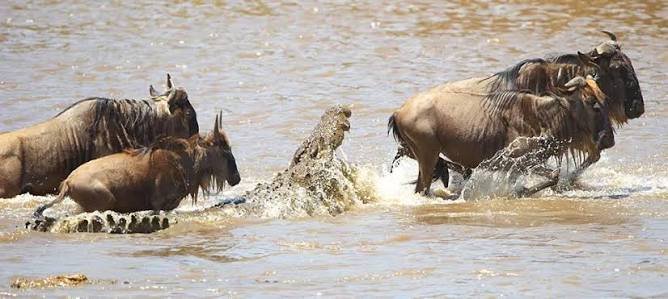
Wildebeest live in environments where predators are always part of the ecosystem.
Lions, hyenas, cheetahs and other predators may prey on young animals when opportunities arise.
A newborn calf that remains on the ground for too long becomes an easy target.
The ability to stand and walk shortly after birth gives the calf a much better chance of staying with its mother.
This is an excellent example of how evolution has shaped wildlife behaviour.
The calf does not need someone to teach it how to stand.
The instinct is already there.
It tries.
It falls.
It tries again.
And eventually, it walks.
The Powerful Bond Between Mother and Calf
One of the most touching aspects of a wildebeest birth is the relationship between mother and calf.
The mother remains close to her newborn during those vulnerable early moments.
The calf needs to identify its mother and stay near her.
As it becomes stronger, the mother and calf can move with the wider herd.
This relationship provides protection, guidance and access to milk and other resources essential for the calf’s development.
For a safari traveller, watching a mother gently remain beside her newborn can be more moving than any dramatic predator encounter.
It is a quiet reminder that maternal care exists throughout the natural world.

The Great Wildebeest Migration and the Birth of Calves
When talking about wildebeest births in Tanzania, it is impossible not to mention the Great Wildebeest Migration.
Every year, enormous numbers of wildebeest move through the Serengeti ecosystem in response to changing rainfall, water availability and fresh grazing.
One of the most spectacular stages of this natural cycle is the calving season.
Large numbers of wildebeest give birth within a relatively concentrated period, creating an incredible scene across the grasslands.
Thousands of newborn calves appear across the plains.
Mothers remain close to their young.
Herds move together.
Predators follow the abundance of vulnerable young animals.
The result is one of the most dramatic examples of the circle of life in Africa.
But it is important to understand that wildebeest births are not limited exclusively to the famous migration calving areas.
Wildebeest also reproduce within other parts of their range, including the Ngorongoro ecosystem.
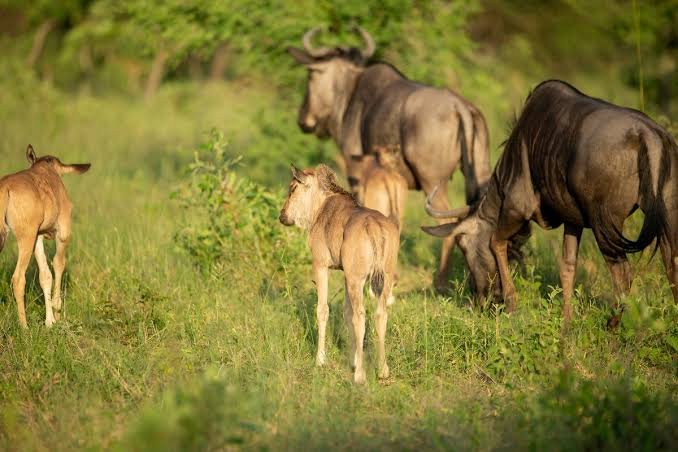
Wildebeest Birth in Ngorongoro Crater
Ngorongoro Crater is one of Tanzania’s most remarkable wildlife destinations.
The crater was formed when a massive ancient volcanic mountain collapsed, creating a huge natural enclosure.
Today, its grasslands, wetlands, forests and water sources support a remarkable variety of wildlife.
Wildebeest are among the herbivores found within this ecosystem.
The crater provides feeding grounds and water that allow many species to survive throughout the year.
When a wildebeest gives birth here, the event becomes part of a much larger ecosystem.
The newborn calf is not alone.
Around it may be zebras, gazelles, buffalo and other herbivores.
Somewhere nearby, predators may be watching.
Birds move across the grasslands.
Hippos remain in water.
The entire ecosystem continues around the newborn calf.
That is what makes the experience so extraordinary.
The Circle of Life in Ngorongoro
A birth in the crater is one small part of the much larger circle of life.
A newborn animal represents hope and continuation.
A growing young animal represents survival.
An adult represents reproduction and the continuation of the population.
Predators, meanwhile, depend on herbivores for food.
Scavengers benefit from remains.
Plants provide food for herbivores.
Rain supports vegetation.
Water sustains the entire system.
Everything is connected.
This is why observing animal births can teach us much more than simply the appearance of a newborn.
It shows us how ecosystems work.
Other Animals That Give Birth in Tanzania
Wildebeest are certainly not the only animals reproducing in Tanzania.
The country’s wildlife is incredibly diverse, and each species has its own reproductive behaviour.
Elephants
Elephants are known for their strong family relationships.
A newborn elephant calf remains closely connected to its mother and other members of the herd.
Other females may also play a role in protecting and caring for young calves.
Watching an elephant family move together can be a beautiful experience.
A small calf walking between enormous adults is one of the most recognizable scenes of the African wilderness.
Zebras
Zebra foals are also born with an impressive ability to become mobile quickly.
Soon after birth, a young zebra needs to keep up with its mother and eventually the herd.
The relationship between a mare and her foal can be fascinating to observe during a safari.
Giraffes
Giraffe calves enter the world in a rather dramatic way because their mothers give birth while standing.
The newborn therefore experiences a surprising first few moments of life.
Despite this dramatic beginning, the calf quickly begins trying to stand and follow its mother.
Seeing a young giraffe beside its towering mother is one of the unforgettable sights of a Tanzania safari.
Buffalo
African buffalo give birth to calves that remain close to their mothers and the herd.
Large buffalo herds provide protection, particularly for younger animals.
Watching a herd move across the savannah can reveal just how important social behaviour is to survival.
Antelopes and Gazelles
Tanzania is home to many species of antelope and gazelle, each with its own reproductive strategy.
Some young animals are capable of moving soon after birth, while others rely on hiding behaviour and parental protection.
This diversity is one of the reasons Tanzania’s ecosystems are so fascinating.
Predators and Newborn Animals
Newborn animals are one of the reasons predators remain closely connected to the reproductive cycles of herbivores.
Lions, hyenas, cheetahs and other predators are constantly searching for opportunities.
This may sound cruel from a human perspective, but predation is a natural part of a healthy ecosystem.
Predators help regulate prey populations and contribute to ecological balance.
For this reason, a wildlife safari can sometimes involve witnessing both sides of the circle of life.
One day you might see a newborn calf.
Later, you might see a lion resting after a successful hunt.
Neither event exists independently.
They are connected.
When Is the Best Time to See Newborn Animals in Tanzania?
There is no single month when every animal in Tanzania gives birth.
Different species reproduce at different times, and births can vary depending on rainfall, food availability and environmental conditions.
The Serengeti’s famous wildebeest calving season is particularly associated with the green season, when fresh grass provides valuable nutrition for mothers and their young.
However, wildlife does not follow a calendar designed for tourists.
A birth can happen unexpectedly.
That is why one of the most important qualities for a safari traveller is patience.
You might spend hours searching for wildlife without seeing anything unusual.
Then suddenly, your guide notices a small movement in the grass.
And there it is.
A new life.
Why Newborn Animals Are So Vulnerable
The first days and weeks of life can be the most dangerous period for many wild animals.
Newborns may struggle with:
- Predators
- Extreme weather
- Lack of water
- Food shortages
- Separation from their mothers
- Competition
- Disease
- Long-distance movement
Yet wildlife has evolved extraordinary ways to deal with these challenges.
Some species hide their young.
Others keep them constantly moving.
Some depend on large herds for protection.
Others rely on camouflage.
The wildebeest’s strategy is particularly impressive: get up and move quickly.
What Makes a Wildebeest Birth So Emotional?
There is something universal about watching a newborn take its first steps.
Humans understand the struggle instinctively.
A child learning to walk takes uncertain steps, falls and tries again.
A wildebeest calf does something remarkably similar, except that its environment demands speed.
There is no comfortable nursery.
No safe house.
No artificial protection.
The calf’s first steps are immediately connected to survival.
That contrast makes the moment so powerful.
You are watching something fragile entering a world that is beautiful, but also unforgiving.
A Safari Is About More Than Seeing Animals
Many first-time safari travellers arrive in Tanzania with a checklist.
They want to see:
Lion.
Elephant.
Leopard.
Rhino.
Buffalo.
The famous Big Five.
And there is nothing wrong with that.
But a truly memorable safari often goes beyond the checklist.
It might be the sight of a mother elephant guiding her calf.
It might be a young zebra running beside its mother.
It might be a giraffe calf trying to reach leaves.
Or it might be a newborn wildebeest taking its first steps.
These quieter experiences often become the memories travellers treasure most.
Responsible Wildlife Viewing During Births
If you are lucky enough to witness an animal giving birth or caring for a newborn, responsible viewing is extremely important.
Animals should never be surrounded by vehicles or forced to change their behaviour simply because visitors want a closer photograph.
A professional guide should maintain an appropriate distance and follow conservation-area regulations.
Visitors should:
- Keep noise low
- Avoid sudden movements
- Never feed wildlife
- Never attempt to touch an animal
- Follow the guide’s instructions
- Avoid pressuring the vehicle to move closer
- Respect the animal’s space
The best wildlife encounter is one where the animals continue behaving naturally.
Photographing a Newborn Wildebeest
A newborn wildebeest can be an incredible subject for wildlife photography.
But the best photographs do not necessarily require getting close.
A telephoto lens or binoculars can help you observe the calf while maintaining a respectful distance.
Try to capture the relationship rather than only the animal itself.
A photograph showing the calf standing beside its mother can tell a much stronger story than a close-up image of the calf alone.
The surrounding landscape can also make the photograph more meaningful.
The crater walls.
The grasslands.
The herd.
The morning light.
Together, these elements tell the story of where that new life began.
Why Ngorongoro Is a Special Place for This Experience
Ngorongoro is more than a wildlife-viewing destination.
It is a remarkable ecosystem where geology, wildlife and conservation come together.
The ancient volcanic landscape creates a dramatic setting, while the crater’s habitats support large numbers of animals.
For a visitor, this means that even an ordinary game drive can become extraordinary.
You may begin the morning looking for lions.
Then you encounter elephants.
A herd of buffalo crosses your route.
A rhino appears in the distance.
And suddenly your guide points toward a wildebeest mother and her newborn calf.
You never know exactly what the day will bring.
That unpredictability is the heart of safari.
The First Steps That Tell a Bigger Story
The first steps of a wildebeest calf may last only a few moments.
But they tell a much bigger story.
They tell the story of adaptation.
They tell the story of motherhood.
They tell the story of survival.
They tell the story of Tanzania’s extraordinary ecosystems.
And they remind us that conservation is not only about protecting famous adult animals. It is also about protecting the habitats where the next generation can be born.
Without healthy grasslands, reliable water and safe wildlife areas, these births would become increasingly difficult.
Protecting Tanzania’s wildlife therefore means protecting the entire ecosystem.
Experience Tanzania’s Circle of Life in 2026–2028
If you are planning a Tanzania safari between 2026 and 2028, Ngorongoro Crater should be high on your list.
The possibility of witnessing a newborn wildebeest taking its first steps is only one part of what makes the destination special.
You may see predators hunting, elephants moving through the grasslands, enormous herds of herbivores, birds filling the skies and dramatic landscapes stretching toward the horizon.
Most importantly, you will experience nature as it really is.
Unpredictable.
Beautiful.
Sometimes peaceful.
Sometimes dramatic.
Always alive.
Book Your Tanzania Wildlife Safari with EKO Tanzania Adventures
If you want to explore Ngorongoro Crater, Serengeti National Park and other remarkable wildlife destinations in Tanzania, EKO Tanzania Adventures can tailor your safari according to your travel dates, number of travellers, accommodation preferences, interests, budget and preferred travel style.
Whether your dream is to witness newborn wildebeest during the calving season, search for the Big Five, follow the Great Wildebeest Migration or simply experience Tanzania’s incredible wildlife at your own pace, your safari can be designed around what matters most to you.
The birth of a wildebeest is a small event in an enormous wilderness.
But when you sit quietly in a safari vehicle and watch that tiny calf struggle to stand, take its first step and finally follow its mother, you realize something beautiful:
In Tanzania, every new life is part of an ancient story that continues across the African wilderness every day.